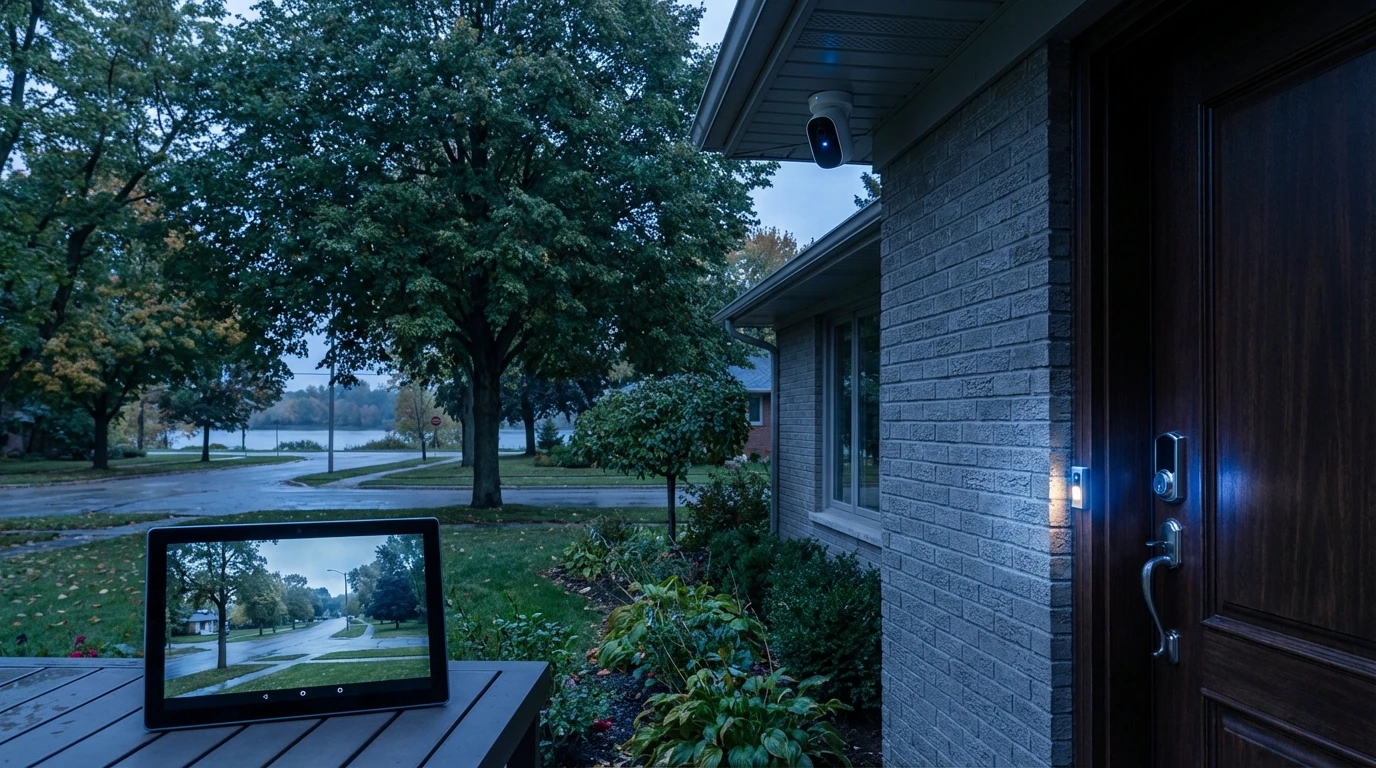
Prepare your security infrastructure for Ontario’s harsh winter. Expert insights on battery performance, hardware ratings, and crime prevention strategies backed by verified industry data.
Strategy Summary
- Cold-Weather Hardware Resilience: Standard cameras fail in deep freezes; specialized units rated for -30°C to +60°C are essential for consistent surveillance.
- Battery Performance Degradation: Expect capacity losses between 20-50% in sub-zero temperatures, requiring proactive power management strategies.
- Seasonal Crime Spikes: Theft rates surge during winter months, with vehicle thefts rising by up to 25% and porch piracy costing billions annually.
- Fire Safety Integration: Heating-related fires peak in winter, necessitating integrated environmental monitoring alongside intrusion detection.
The Escalating Threat Landscape of Canadian Winters
Winter in Ontario brings more than just plummeting temperatures and heavy snowfall; it introduces a unique set of security vulnerabilities that threaten both residential and commercial properties. As daylight hours shorten and weather conditions deteriorate, criminal activity adapts, creating a distinct seasonal threat profile that demands robust countermeasures. Security professionals observe a measurable shift in risk dynamics during the colder months, driven by environmental factors and opportunistic behavior.
Analyzing the Seasonal Crime Surge
Data consistently indicates that the cover of darkness and the distraction of severe weather provide ideal conditions for illicit activities. Burglary rates, in particular, demonstrate a concerning upward trend as the days grow shorter.
- Burglary Frequency: Research from Verisure highlights that properties are 1.14 times more likely to be burgled during the darker winter months compared to summer. This statistical probability necessitates a re-evaluation of perimeter lighting and motion detection sensitivity.
- Vehicle Vulnerability: The practice of ‘puffing’—leaving a car running to warm up—has led to a sharp increase in vehicle thefts. The National Insurance Crime Bureau (NICB) reports that 84,267 vehicles were stolen with the keys left inside, a scenario predominantly occurring during winter mornings.
- Insurance Claims: Further reinforcing this trend, NC Insurance notes a rise in car thefts of up to 25% during the winter months, underscoring the need for surveillance systems that cover driveways and parking lots effectively.
Hardware Survival: Navigating Temperature Extremes
Electronic security components are sensitive to thermal extremes. In Ontario, where temperatures can swing drastically, standard consumer-grade equipment often succumbs to the elements, leading to critical failures exactly when surveillance is most needed. Specifying the correct hardware is not merely a recommendation; it is an operational necessity.
Temperature Ratings and IP Standards
Understanding the operational thresholds of security cameras is vital for ensuring uninterrupted service. Most generic electronics are not designed for the Canadian Shield’s deep freeze.
- Standard vs. Extreme Ratings: While many outdoor cameras claim weather resistance, professional-grade systems offer vastly superior endurance. Reconeyez outlines that standard professional gear often operates between -20°C to +50°C (-4°F to 122°F). However, for true winter resilience in exposed northern areas, specialized ruggedized units rated for -30°C to +60°C (-22°F to 140°F) are required to prevent internal component freezing.
- Ingress Protection (IP): Beyond temperature, the ingress of moisture from melting snow and ice dams poses a severe threat. Systems must boast high IP ratings (IP66 or IP67) to prevent water from compromising internal circuitry during freeze-thaw cycles.
- Housing Considerations: Heated housings are often necessary for PTZ (Pan-Tilt-Zoom) cameras to prevent the motors from freezing and to keep lenses clear of frost and condensation.
Power Management and Battery Chemistry in the Cold
Wireless security systems, while convenient, face significant challenges in sub-zero environments. Lithium-ion batteries, the industry standard for wire-free cameras and sensors, rely on chemical reactions that slow down dramatically as temperatures drop. This results in a phantom loss of capacity that can leave properties vulnerable without warning.
Quantifying Capacity Loss
Security integrators must account for substantial performance degradation when designing wireless networks for winter deployment.
- Capacity Reduction: According to Alfred Camera, users can expect a 20-50% capacity loss in security camera batteries during cold snaps. This drastic reduction means maintenance schedules must be accelerated.
- Daily Discharge Rates: Even without active triggering, the cold accelerates passive drain. Large Battery notes that low temperatures can cause a 1% to 4% daily drop in battery life purely due to environmental conditions.
- Total Efficacy Drop: In extreme scenarios, Large Battery also highlights a general 10-20% capacity loss as a baseline in moderate cold, which worsens as the mercury falls further.
Mitigation Strategies
To combat these physical limitations, hardwiring power sources is the gold standard for Canadian winters. Where hardwiring is impossible, employing solar panels positioned to catch the low winter sun or utilizing external battery packs with insulation can extend operational windows.
Combating the Holiday Retail Theft Epidemic
For commercial clients and retail business owners, the winter season coincides with the busiest shopping period of the year. This influx of foot traffic creates a chaotic environment that organized retail crime rings and opportunistic shoplifters exploit aggressively. Security systems must be tuned to handle high-density environments and rapid entry-exit events.
The Statistical Reality of Holiday Shrinkage
The correlation between the holiday season and inventory loss is undeniable, driven by darker evenings and crowded stores.
- Retail Theft Spikes: Legal experts at Kefalinos Law indicate that retail theft incidents account for over 80 percent of crimes during the holidays, overwhelming loss prevention teams.
- Organized Retail Crime (ORC): The sophistication of these attacks is also increasing. The National Retail Federation reported a staggering 93% increase in organized retail crime incidents, necessitating advanced video analytics and facial recognition technology to identify repeat offenders.
Strategic Countermeasures
Effective defense requires a layered approach. High-resolution cameras at point-of-sale terminals, integrated with transaction data, can flag anomalies in real-time. Furthermore, public view monitors (PVMs) placed at entrances serve as a psychological deterrent, signaling to potential bad actors that the premises are under active surveillance.
The Rise of Porch Piracy and Package Theft
The shift towards e-commerce has birthed a relatively new but rampant category of crime: porch piracy. As delivery volumes peak in December and January, residential front porches become prime targets. This is no longer a nuisance crime; it is a multi-billion dollar illicit industry that affects millions of households.
The Billion-Dollar Problem
The scale of package theft has grown exponentially, tracking closely with the rise of online shopping.
- Financial Impact: A report by the E-Commerce Times estimates that porch pirates pilfered $12 billion in goods in 2024 alone, spread across approximately 91 million incidents.
- Widespread Victimization: The reach of this crime is vast. Xtown reports that an estimated 58 million Americans have been victims of package theft, a trend mirrored in Canadian urban centers.
- Reporting Surges: Localized data confirms the seasonal spike. Xtown noted that package theft reports jumped to 436 reports in peak months compared to a 295 average during the rest of the year.
Technological Interventions
Video doorbells with AI-driven package detection are the first line of defense. These devices can send instant alerts when a courier arrives and, crucially, when a package is moved. Integrating smart locks to allow verified in-garage or in-home delivery is becoming an increasingly popular solution for high-value deliveries.
Fire Safety: The Overlooked Winter Risk
While intrusion is a primary concern, environmental monitoring is equally critical during Ontario winters. The extensive use of heating systems, fireplaces, and space heaters significantly elevates the risk of residential and commercial fires. A holistic security system does not just watch for burglars; it sniffs out smoke and carbon monoxide.
Heating Fire Statistics
The intersection of cold weather and heating equipment usage creates a predictable but deadly hazard window.
- Peak Danger Periods: The National Fire Protection Association (NFPA) states that 46 percent of home heating equipment fires occur during the winter months of December, January, and February.
- System Integration: Modern security panels should be integrated with monitored smoke and heat detectors. Unlike standard detectors that simply sound an alarm, monitored systems dispatch emergency services immediately, which is crucial if a fire starts when the property is unoccupied or residents are asleep.
- Carbon Monoxide (CO): With windows sealed tight against the cold and furnaces running overtime, CO buildup is a silent killer. Integrated CO detectors are a mandatory component of any winter-proofed security ecosystem.
Actionable Maintenance Checklist for Winter
Installing the right hardware is only half the battle; maintaining it ensures longevity and reliability. A pre-winter inspection can prevent system failure during a blizzard when repairs are most difficult to execute. The following protocol is recommended for all security infrastructure in Ontario.
Exterior Maintenance Steps
- Lens Cleaning: Wipe down all camera lenses with an anti-fog solution. Dirt and spiderwebs accumulated during autumn can freeze onto the lens, obscuring the view and confusing auto-focus mechanisms.
- Cable Inspection: Check all exposed cabling. Cold weather makes plastic cable sheathing brittle and prone to cracking. Ensure conduit is intact and seals are watertight.
- Power Backup Testing: Test Uninterruptible Power Supplies (UPS) and backup batteries. Cold weather often accompanies ice storms that cause power outages; ensure your system can stay online for extended periods without grid power.
- Sensor Calibration: Re-calibrate motion sensors. Snow accumulation can alter the landscape, potentially creating blind spots or causing false alarms due to shifting snow drifts.
Fortifying Your Perimeter Before the Freeze
The data is clear: winter in Ontario presents a compounded risk environment where mechanical failure meets heightened criminal activity. From the 25% rise in vehicle thefts to the $12 billion cost of porch piracy, the stakes are financially and operationally significant. By prioritizing industrial-grade hardware rated for extreme cold, implementing robust power management strategies, and integrating environmental monitoring for fire safety, property owners can turn their security systems from passive observers into active defenders.
Do not wait for the first deep freeze to discover the limitations of your current setup. For a comprehensive assessment of contact us today!